


Japanese investment funds series: The Cayman unit trust explained
Update
Update
Following our first article covering ‘Why the Cayman unit trust remains the preferred choice for Japanese investors‘, this is the second article in our Japanese investment funds series.
Although a fund structured as a Cayman unit trust is likely familiar to Japanese investors, it may be less familiar to other parties involved. This article therefore sets out the high-level foundations of a Cayman unit trust, covering its establishment, parties, documentation, operation, unit dealing, termination and regulation. In later articles, we will consider topics such as the structuring and lifecycle of a Cayman unit trust.
What is a Cayman unit trust?
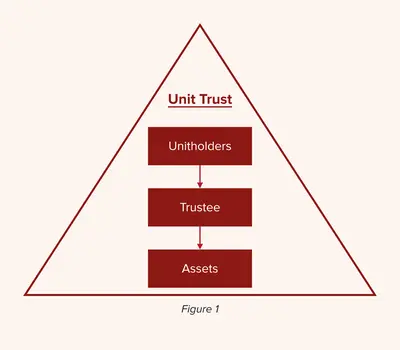
A Cayman unit trust is a legal relationship, governed by a trust deed, under which an individual or company known as a trustee holds and manages a collection of assets on behalf of certain beneficiaries known as unitholders. The trustee holds legal title to the assets, while the unitholders hold beneficial interests represented by their units. This separation of legal and beneficial ownership is a central feature of the structure. Unlike a company, a unit trust is not itself a separate legal entity. See Figure 1 below.
Figure 1
How is a Cayman unit trust established?
Execution of a trust deed by the trustee records the terms on which the trustee will hold the assets on behalf of the unitholders, but execution alone does not guarantee that the unit trust has been validly established. A unit trust also requires ‘three certainties’ to be present, namely a clear intention to create a trust, identifiable trust property or assets, and identifiable beneficiaries or unitholders.
In the context of an investment fund structured as a Cayman unit trust, those three elements are ordinarily satisfied by the execution of the trust deed together with the first closing, when an investor has subscribed for and been issued units and has paid or is liable to pay the corresponding subscription monies or assets for those units. Only at that point does the trustee hold trust assets on behalf of identifiable unitholders. The precise timing of establishment therefore depends on the terms and implementation of the trust deed and offering document.
Is registration required to establish a Cayman unit trust?
Unlike an exempted company or an exempted limited partnership, which come into existence on incorporation or registration, as evidenced by a certificate, a unit trust is constituted by the trust deed and the ‘three certainties’ being present, and does not need to be registered for that purpose.
Registration under the Trusts Act
A Cayman unit trust may, however, obtain a certificate of registration issued by the Registrar of Trusts (the Registrar) if it is registered as an exempted trust under section 74 of the Trusts Act (as amended) of the Cayman Islands (the Trusts Act).
Registration involves filing the trust deed with the Registrar and paying the prescribed fee. The Registrar will issue the certificate if it is satisfied, on an application made by the trustee, that the beneficiaries do not and are not likely to include any person who is at any time resident or domiciled in the Cayman Islands (other than the object of a charitable trust or power).
Whilst counterparties often request this certificate and treat it as evidence that the trust has been established, it is mostly relevant if the trustee wishes to obtain the statutory tax undertaking available to an exempted trust.
Tax undertaking
Under that undertaking, the Financial Secretary of the Cayman Islands undertakes that, in accordance with section 81 of the Trusts Act, for a period of 50 years from the date of creation of the trust, no Cayman Islands law enacted after that date imposing any tax or duty on income, capital assets, capital gains or appreciation or any tax in the nature of estate duty or inheritance tax will apply to the trust property, any income arising under the trust or to the trustee or to unitholders in respect of such property or income.
Fund sponsors commonly opt for the undertaking because it gives investors and fund parties long-term certainty that the fund will not be exposed to any future Cayman Islands taxation, and it is particularly expected in fund structures involving institutional investors.
Who are the parties involved in a unit trust?
Unitholders are the beneficial owners of the assets of the trust and will not generally be parties to the trust deed. They subscribe for units pursuant to a subscription agreement with the trustee.
Trustee
The trustee is the legal owner of the assets in the Cayman unit trust and holds them on behalf of unitholders. Whilst the trustee could theoretically be an individual or domiciled elsewhere, for Cayman unit trusts established for Japanese investors, it is often a professional company licensed under the Banks and Trust Companies Act (as amended) of the Cayman Islands. The trustee is also the operator of the fund, in the same way that the directors of a company or the general partner of a limited partnership are its operators.
The trustee is typically vested with all of the powers and duties set out in the trust deed, although in some structures a management company is also a party to the trust deed (ie in a two-party structure) and is vested with certain functions to the exclusion of the trustee. This two-party structure will be discussed in a later article.
The trustee will usually delegate defined functions to specialist service providers and is largely passive on a day-to-day basis once the various service providers have been appointed. The trustee does, however, retain high level supervisory duties.
Service providers
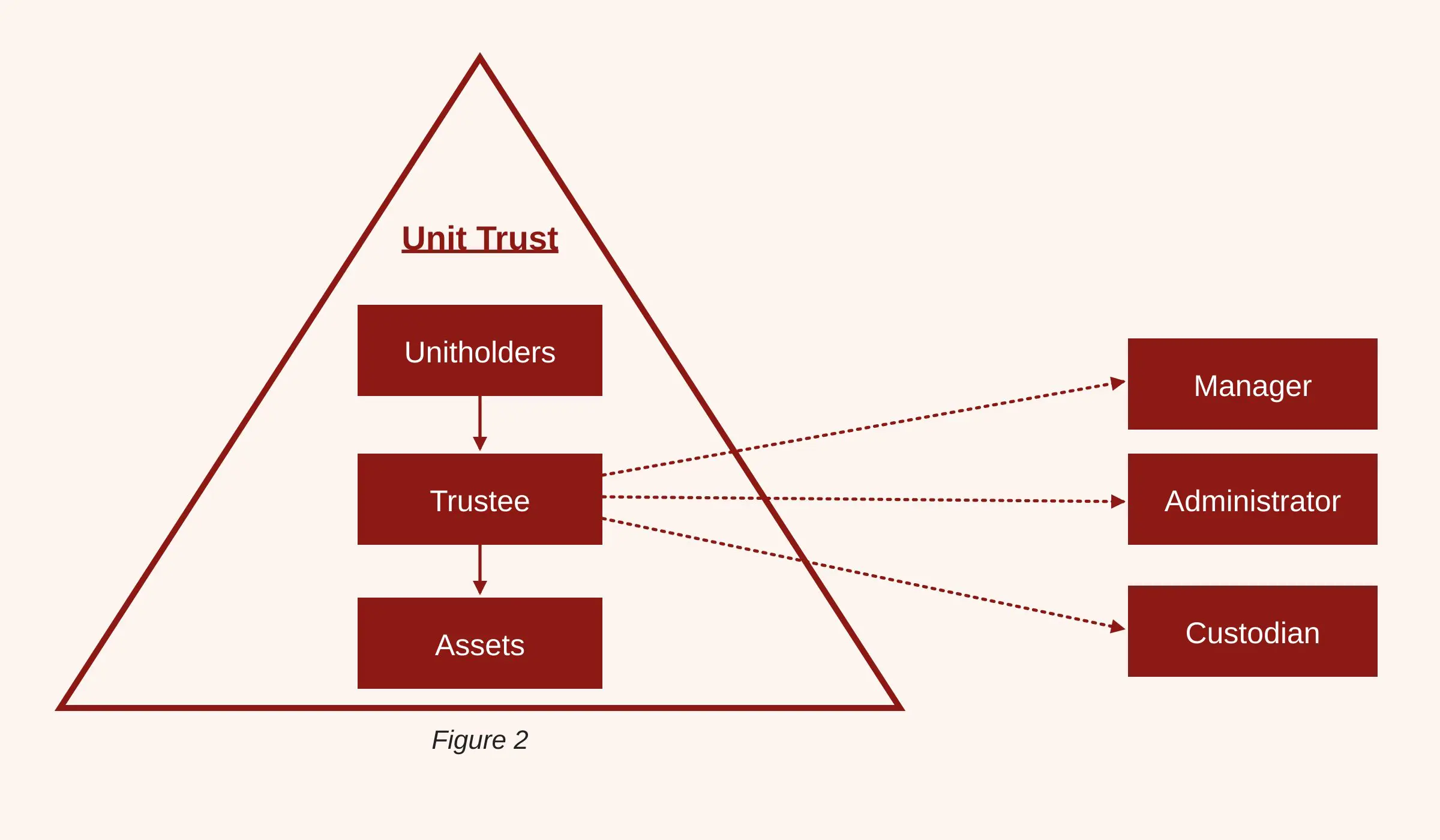
Investment management, as well as other important operational functions, is commonly delegated to an investment manager. The calculation and publishing of the net asset value and transfer agency functions, as well as others, are usually delegated to an administrator and/or transfer agent. The safekeeping of monies or assets is normally delegated to a custodian.
Other service providers are also often appointed by the trustee in these structures. The investment manager, administrator and custodian can be located outside the Cayman Islands, subject to Cayman regulatory requirements. See Figure 2 below.
Figure 2
The trustee will also arrange for the appointment of an auditor, where one is required or desired. A mutual fund or private fund subject to Cayman Islands Monetary Authority (CIMA) regulation pursuant to the Mutual Funds Act or the Private Funds Act (both as amended) of the Cayman Islands must appoint an auditor approved by CIMA, and have its annual financial statements audited and filed with CIMA.
What are the core documents for a Cayman unit trust?
The principal documents are the trust deed, the offering document, the subscription agreement and the agreements appointing the unit trust’s service providers. Together, they establish the legal relationship between the trustee and the unitholders, describe the contractual terms of investment and allocate responsibility for the operation of the fund.
Trust deed
The trust deed is the unit trust’s principal constitutive document and sets out:
- the terms on which the trustee holds the trust property;
- the rights attaching to the units;
- the powers and duties of the trustee; and
- certain procedures including, without limitation, relating to subscriptions, transfers, repurchases, distributions, valuation and termination.
Where the fund is established as an umbrella, the principal trust deed will ordinarily be supplemented by a separate supplemental trust deed for each series or sub-trust. The detailed structuring considerations for umbrella arrangements will be considered in a later article.
Offering document
Trust deeds often defer to the offering document for detailed procedures, which can be more easily amended than the trust deed itself. The offering document also sets out the fund’s investment objective and strategy, dealing terms, fees, risks, governance and service-provider arrangements. Where the fund is regulated by CIMA as a mutual fund or private fund, additional requirements apply, including initial and ongoing filings and prescribed offering document content.
Subscription agreement
An investor applies for units under a subscription agreement or application form, which records its subscription, representations and undertakings and typically includes eligibility, anti-money laundering and data-protection information. The subscription agreement typically incorporates the terms of the trust deed and the offering document by reference, and is the principal document executed by investors.
Service provider agreements
The trustee will also typically enter into agreements appointing the relevant investment manager, administrator, custodian and other service providers. A separate management agreement may not be required where the investment manager is itself a party to a two-party trust deed and its appointment, powers and duties are set out in that trust deed.
What powers and duties do trustees have?
Powers
The trustee’s powers are principally set out in the trust deed and are supplemented by the Trusts Act. They will commonly include broad powers to:
- acquire, hold and dispose of investments;
- open and operate bank and custody accounts;
- borrow and grant security;
- enter into contracts;
- issue, transfer and repurchase units;
- declare suspensions;
- determine distributions;
- appoint agents and service providers;
- settle fees and expenses out of the assets of the unit trust; and
- take any other action considered necessary or desirable for the administration of the unit trust.
Those powers are exercisable only for the purposes for which they were conferred and subject to any limitations, requirements or directions contained in the trust deed.
Although the trustee may have extensive powers, it will ordinarily delegate much of the unit trust’s day-to-day operation. Delegation does not, however, remove the trustee from the structure or automatically discharge its responsibilities. The trustee must exercise due care in selecting appointees and retain an appropriate level of oversight.
Duties
The trustee is obliged to:
- comply with the trust deed;
- act honestly and in good faith for the benefit of the unitholders as a whole;
- exercise its powers for proper purposes;
- avoid unauthorised conflicts;
- preserve the trust property separately from its own proprietary assets;
- account for its administration of the trust;
- maintain or procure the maintenance of appropriate records; and
- treat unitholders in accordance with the rights attaching to their units.
How does a Cayman unit trust contract?
A unit trust is not a separate legal entity but a name given to the assets held on trust by the trustee for the unitholders. It therefore cannot enter into contracts, make investments, or sue or be sued in its own name. Instead, the trustee, as legal owner of the assets, contracts and transacts for the account of the unit trust.
The trustee will not usually exercise day-to-day operational control. Instead, the investment manager and other service providers perform their delegated functions within the authority given to them. For example, an investment manager may execute an investment as agent for the trustee, in the trustee’s name and for the account of the unit trust. The resulting rights and obligations are still those of the trustee, notwithstanding that the manager negotiated or executed the transaction.
Transaction documents should therefore identify the trustee as the contracting principal and make clear that it acts as trustee of, and for the account of, the unit trust. When an authorised investment manager signs on the trustee’s behalf, the language should distinguish the investment manager’s agency from the trustee’s status as principal.
What is the trustee’s exposure and how is it mitigated?
Because the trustee contracts as principal, it is generally liable to the counterparty for obligations incurred under the contract.
The trustee will ordinarily have a right of indemnity out of, and recourse to, the trust assets for liabilities properly incurred in the administration of the trust. In the ordinary course, the trustee will use the trust assets to settle the counterparty’s claim. That protection may be unavailable or impaired where the liability falls outside the scope of the indemnity, including because of the trustee’s own breach of trust or other disqualifying conduct.
The commercial risk is that the trustee’s liability to a counterparty may exceed both the value of the available trust assets and the protection afforded by its indemnity. Unless the contract provides otherwise, the counterparty may then seek recovery from the trustee’s proprietary assets.
Professional trustees therefore seek to include an effective limited recourse clause in transaction documents restricting the counterparty’s recourse to the assets of the unit trust. This places the counterparty in a position similar to contracting with a corporate entity, with claims limited to that entity’s assets.
When a trustee appoints an investment manager to execute transactions on its behalf for the account of the unit trust, the power of attorney in the investment management agreement will typically require the investment manager to ensure that any agreements entered into as agent of the trustee also include the trustee’s form of limited recourse language.
What are units?
The beneficial interest in the assets of the unit trust is divided into units, each of which represents an equal undivided share of that interest. A unit gives the unitholder a proportionate beneficial interest in the assets of the unit trust as a whole, but not legal title to any particular asset held by the trustee. The rights attaching to a unit, including without limitation rights to distributions, repurchase proceeds and voting, are determined by the trust deed and, where applicable, the offering document.
How are units issued?
Units may be issued in separate classes and, similar to shares in a company, units within the same class rank equally and carry the same rights. Units may also be issued in separate series, which may differ in certain economic terms such as the calculation of fees. Units may also be issued in fractions.
Units are typically issued to unitholders by the trustee in accordance with the trust deed, although this function is sometimes vested in a management company in a two-party trust deed structure for an offering to Japanese retail investors, which will be discussed in a later article.
Unlike shareholders in an exempted limited company, a unitholder does not have limited liability by statute. Trust deeds therefore customarily provide that a unitholder is not liable to contribute to the trust beyond the subscription price of its units, and the extent of that protection depends on the terms of the trust deed.
The process to apply for units typically requires an investor to submit a subscription application and pay subscription monies to the trustee in accordance with the dealing terms set out in the offering documents. The timing and procedure are typically dictated by the administrator’s processes and procedures, as well as investor preferences, the distribution channel and type of investments being made. For example, it is common for Japanese investors to request a post-dealing settlement cycle, often of 3 business days (ie T+3).
The price at which units are issued is typically fixed for the initial subscription, with units being subscribed at net asset value per unit for subsequent subscriptions, subject to any subscription charge, although this may differ depending on the structure.
The administrator or transfer agent commonly processes subscriptions and maintains the register of unitholders on behalf of the trustee, but the legal power to issue units derives from the trust deed and is typically exercised by, or under the authority of, the trustee.
The trustee will only recognise the unitholder recorded in the register as the absolute owner. In other words, only the unitholder recorded in the register will be recognised as having any right, title or interest in or to a unit. Beneficial owners of the unitholder, or persons on behalf of whom the unitholder holds the units, are not recognised.
How are units transferred or repurchased?
Transfer
A transfer changes the registered ownership of existing units. The transfer procedure is governed by the trust deed and, where applicable, the offering document, and will usually require an instrument of transfer, evidence satisfactory to the trustee or administrator, compliance with eligibility and anti-money laundering requirements and registration of the transferee in the register of unitholders. Often additional Japanese resale restrictions will apply, depending on the channel of distribution in Japan.
Repurchase
A repurchase (also sometimes referred to as a redemption) is the cancellation of units in return for payment to the unitholder from the assets of the unit trust. In an open-ended unit trust, a unitholder will ordinarily request repurchase of units in accordance with the dealing procedures set out in the trust deed and offering document, including any notice period, dealing day and minimum holding requirements. The repurchase price is generally calculated by reference to the net asset value per unit at the relevant valuation point, subject to any applicable fee, adjustment or deduction.
The trust deed will also commonly permit the trustee to:
- suspend the calculation of the net asset value, the issue and repurchase of units;
- delay the payment of repurchase proceeds for a certain period;
- compulsorily repurchase units; or
- gate repurchases in specified circumstances.
Once the units held by a unitholder are repurchased, the unitholder’s beneficial interest is reduced accordingly. If all of a unitholder’s units are repurchased, that person ceases to be a beneficiary of the unit trust. If all units of a unit trust are repurchased, the unit trust will cease to exist as a matter of law, as there are no longer any identifiable unitholders (see the termination section below).
How is a Cayman unit trust terminated?
Although less relevant in the context of an investment fund structured as a Cayman unit trust, a Cayman unit trust can be established for an unlimited duration by disapplying the rule against perpetuities and thus creating a perpetual trust. This is distinct from many other jurisdictions which impose a maximum trust period at the end of which the trust must terminate. If the rule is not disapplied in the trust deed, a 150-year perpetuity period will apply.
Other than termination by expiry of a 150-year perpetuity period, a unit trust may be brought to an end in two principal ways.
First, all units may be compulsorily or voluntarily repurchased. When remaining assets are realised, liabilities discharged, and repurchase proceeds paid to unitholders, the trust will cease to exist as a matter of law as there will be no assets held on trust nor any beneficiaries.
Second, the trustee or another specified person may exercise an express termination power, or a termination event may occur, under the trust deed or, where applicable, the offering document. The trust deed will ordinarily prescribe a detailed process to be followed in respect of the realisation of the remaining assets, discharge of liabilities and payment of a final distribution to investors.
From a Cayman legal perspective, both routes can extinguish the unitholders’ interests and bring the unit trust to an end. The method of termination often depends on the administrator’s processes, as well as other accounting, tax or regulatory considerations.
How is a Cayman unit trust regulated?
A Cayman unit trust is governed by its trust deed, together with the Trusts Act and Cayman common law and equitable principles. The Trusts Act addresses matters including, without limitation, the appointment, retirement and replacement of trustees, the vesting of trust property, certain trustee powers and duties, and the registration of exempted trusts.
Some of its provisions are mandatory and apply regardless of the terms of the trust deed, while others are default rules that apply only to the extent the trust deed does not provide otherwise.
If the unit trust falls within the statutory definition of a mutual fund or private fund, it must be registered or licensed with CIMA unless an exemption applies. Broadly, the Mutual Funds Act applies to funds in which investors may redeem their interests at their option, while the Private Funds Act applies to closed-ended funds. Other Cayman requirements also apply, including without limitation anti-money laundering and data-protection obligations.
The Retail Mutual Funds (Japan) Regulations (the Regulations) provide a Cayman regulatory framework for a ‘retail mutual fund’ within the meaning of those Regulations. Where they apply, they impose requirements concerning, among other things, the fund’s constitution, administrator, custodian, investment adviser, financial reporting, audit and prospectus.
They apply only to a mutual fund that is licensed by CIMA under section 4(1)(a) of the Mutual Funds Act and offered to the public in Japan. A fund that is not licensed under that section, or that is not offered to the public in Japan, falls outside the Regulations. A later article will consider public offerings in Japan in more detail.
Up next in our Japanese investment funds series
In the next article in our Japanese investment funds series, we will explore how to structure a Cayman unit trust for Japanese investors.
You can view the first article in the series here and the other articles in our Japanese investment funds series here.
Key contacts
Our Japanese funds team, based across the Cayman Islands, Hong Kong, London and Singapore delivers responsive Cayman Islands legal advice, providing real-time support to clients across Japan and other regions.
If you have any questions on the topics covered in this article, please get in touch with the contacts on this page.
Contact



This update is only intended to give a summary and general overview of the subject matter. It is not intended to be comprehensive and does not constitute, and should not be taken to be, legal advice. If you would like legal advice or further information on any issue raised by this update, please get in touch with one of your usual contacts. You can find out more about us and access our legal and regulatory notices at mourant.com. © 2026 MOURANT ALL RIGHTS RESERVED

Investment Funds
 News
 Update
9 November 2026
Global Perspectives: Politics and the price of capital in 2027
 News
 Update
2 November 2026
Rated note feeders: Cayman Islands
News
2 November 2026
Mourant shortlisted for Most Innovative Law Firm Strategy
 Update
27 October 2026
Multilaw Collateral Snapshot (Cayman Islands)
Sign up
Subscribe to keep up-to-date with the latest news, updates, legal guides and thought leadership articles.
Ready to take the next step? Let’s talk.
Send our team a message and we’ll be back in touch with you.